


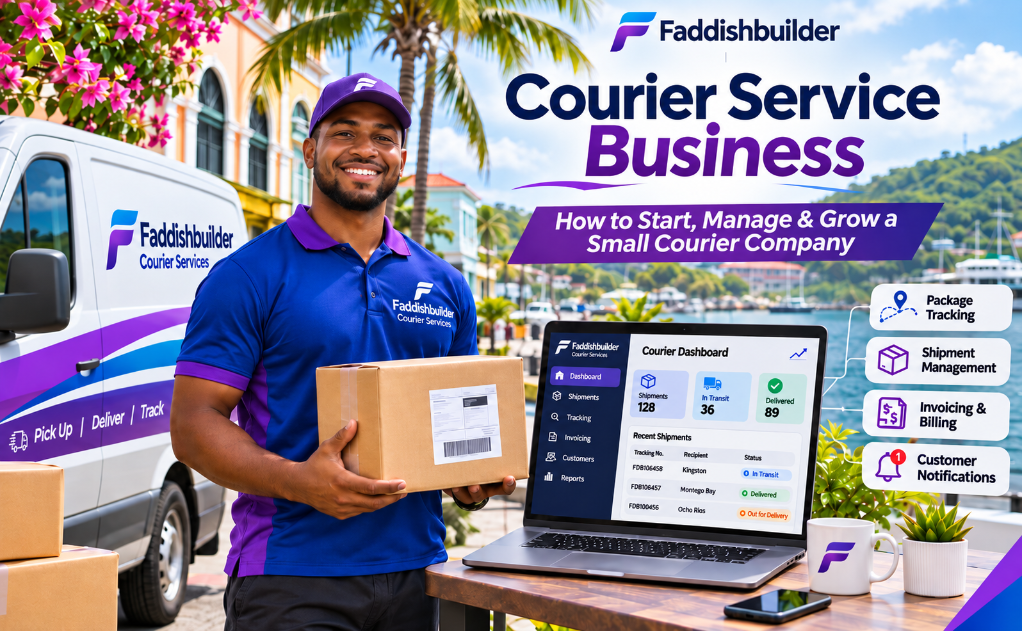
Starting a courier service business can be an opportunity for entrepreneurs who want to help individuals and companies move parcels reliably. Whether you are planning a courier service small business in Jamaica, Trinidad and Tobago, the Bahamas, or another Caribbean market, success depends on more than collecting boxes: you need clear pricing, accurate package records, dependable customer communication, and a payment process that works. This guide explains how to plan, launch, and manage those operations using practical business methods and Faddishbuilder Courier Management.
 A well-organized local courier counter helps customers collect packages and staff maintain accurate shipment records. Illustrative image.
What Does a Courier Service Business Do?
A courier business handles the movement, receipt, tracking, and handover of packages for customers. The exact service varies by business model:
In many Caribbean markets, package forwarding and branch-based collection are important options. A small operator might begin with one pickup location and an overseas freight partner, rather than purchasing a fleet of vehicles. A courier software platform should fit the actual business model: package and customer management is not the same thing as live vehicle routing or driver dispatch.
How to Start a Courier Service Small Business in the Caribbean
1. Choose a specific customer and service area
Define whether you will serve online shoppers, local e-commerce merchants, small offices, or a combination. Specify your service boundaries, pickup hours, service-level promises, and whether you will handle air freight, ocean freight, local delivery, or collection only. Start with a manageable scope and expand when you can consistently meet your promises.
For example, a new Jamaica-based courier could focus on overseas shopping packages collected in Kingston, then add a Montego Bay branch after it has proven its operating process and demand.
2. Register your business and check shipping requirements
Choose a business name, register the appropriate entity, and investigate business, tax, premises, transport, insurance, and import-related requirements for your country. Cross-border operators should confirm which activities they can conduct themselves and which require licensed freight forwarders, customs brokers, carriers, or other partners.
For Jamaica, the Jamaica Customs Agency's commercial import clearance guidance explains documentation such as supplier invoices, airway bills or bills of lading, and permits where applicable. The rules and charges depend on the shipment; do not advertise a universal duty rate or guaranteed clearance time.
3. Establish carriers, overseas receiving arrangements, and handling procedures
If you offer package forwarding, arrange the overseas receiving location, international freight transport, and local customs-handling process before taking customer orders. Verify your partners' terms, prohibited-items rules, claims process, transit schedules, and liability limits. Set up a documented receiving procedure with customer identifiers, proof of condition, and exception handling for damaged or unidentified parcels.
4. Build a transparent courier pricing model
Estimate the full cost of service, including international freight, warehousing, customs administration, local transport, packaging, payment fees, salaries, software, and loss or damage allowances. Decide whether your customer-facing fees depend on actual weight, volumetric weight, package category, branch, or another published rule. Explain where government charges and third-party costs are added.
Whether doorstep delivery costs more than branch pickup
Illustrative invoice only: freight J$2,800 + assessed import charges J$950 + disclosed documentation fee J$250 = J$4,000. This is a calculation example, not a rate quote or estimate of applicable taxes.
5. Set up your website and customer onboarding
A professional website should answer the questions customers ask before they ship: Where is my receiving address? How much does shipping cost? What items are restricted? When can I collect? What happens when a package is delayed?
Use the Faddishbuilder AI Website Builder to draft pages for services, pricing, branch locations, policies, contact details, and frequently asked questions. Review the AI-generated copy for accuracy before publishing. If you want to gather quote requests or new-customer enquiries, the Faddishbuilder Form Builder can collect submissions from your website and route them into your customer workflow.
6. Put a package-management process in place
Before your first shipment arrives, decide who records each package, which tracking identifier is used, how weights are checked, how exceptions are logged, and who may change a shipment's status. Spreadsheets can work at very low volume, but inconsistent manual records create avoidable errors as orders grow.
With courier management software for small businesses, teams can keep package records, shipment statuses, branches, customer invoices, and payment information together instead of relying on scattered chats and notebooks.
How Faddishbuilder Helps You Manage Courier Packages and Customers
Faddishbuilder's Courier Management platform is designed for the workflow from warehouse arrival through customs, invoicing, and pickup. It runs in a web browser and connects to a customer portal and FaddishPay for invoice payments. Here are the practical features a new courier company can use.
Record packages individually or import shipments in bulk
Log each parcel's customer name, tracking number, seller, weight, dimensions, and air or ocean freight method. When a shipment contains many parcels, use CSV import to save repetitive entry time. Import customer records as needed, then check for duplicates or mismatched tracking numbers before confirming receipt.
Keep customers informed with shipment status updates
Use defined statuses such as arrived at warehouse, in transit, processing customs, delayed, awaiting invoice, paid, ready for pickup, picked up, and delivered. Faddishbuilder can send status-change emails with editable messages and placeholders. This gives customers a clearer view of where their packages stand and can reduce repetitive “Is my package ready?” enquiries.
Give customers a self-service client portal
Customers can sign in to view their packages, see status information, upload purchase invoices, download their invoices, and pay online where a supported payment option has been configured. A customer portal for a courier service helps centralize information that might otherwise be lost across email threads and messaging apps.
Combine package charges into clear invoices
Generate an invoice for multiple packages and itemize freight, duty, insurance, documentation, and tax where applicable. Use the invoice designer to add your branding and make the charges understandable. When customers can see what they are paying for, there is less room for confusion at pickup.
Accept online payments and manage branches
Faddishbuilder supports online payment of courier invoices through FaddishPay when a compatible gateway is connected and the relevant plan supports online payments. The platform can mark successful online invoices as paid; counter payments can be recorded manually. Add branches, assign customers to their collection location, and review reports by branch or freight mode. Branch availability and other features depend on your subscription plan.
Watch: Starting a Courier Service Business with Faddishbuilder
The video below is a useful companion to understand the courier management system. Watch it then review the Faddishbuilder delivery management tools, you can configure your own courier workflow.
Video: Faddishbuilder courier business explained. Open the video on YouTube if it does not display on your device.
A Practical Faddishbuilder Courier Management Setup Checklist
Follow this sequence when moving from a new account to a working package counter:
The system records package and customer workflows; your team and logistics partners remain responsible for actually transporting goods, meeting customs obligations, and completing handovers.
Example: How One Customer Package Moves Through the Process
Imagine a customer in Jamaica orders shoes from an overseas retailer. They send the parcel to the overseas receiving address supplied by their courier provider. Once the parcel reaches the operator's handling network, the team records its customer, seller, tracking number, and weight.
When the goods are shipped, the operator updates the package status. During clearance, the business requests any needed purchase invoice or other documentation. After applicable charges are established, the courier creates an itemized invoice and notifies the customer. The customer checks the invoice in the portal, pays online if enabled, and collects the parcel at the assigned branch after the status changes to ready for pickup.
This example illustrates a common workflow, not a guaranteed transit time or a substitute for a licensed customs-clearing process. It also shows why clear tracking, accurate invoices, and communication matter at every stage.
Marketing a Courier Service Business: How to Find Your First Customers
Building an operating system is one part of launching a business. New customers also need to find and trust your service.
Make your website useful for local search
Create a clear page for each genuine service area or branch rather than dozens of near-identical pages targeting different towns. Use natural phrases such as courier service in Kingston, package forwarding in Jamaica, air and ocean freight, and package pickup near me only where they accurately describe the service. Publish your real hours, contact details, address, shipping policies, and FAQs. If eligible, maintain an accurate Google Business Profile for your genuine customer-facing location.
Build partnerships with local sellers
Approach e-commerce stores, clothing boutiques, wholesalers, and other businesses whose customers need reliable package handling. Offer a transparent service agreement, realistic handover cutoffs, and clear procedures for missing or damaged goods. A few dependable merchant partnerships can be more valuable than untargeted promotions.
Use helpful content instead of repetitive ads
Publish articles that explain how package forwarding works, how to understand shipping invoices, when to choose air versus ocean freight, and what documents are needed for customs clearance. Share customer education content through your website and social channels. Do not promise delivery dates, discounts, or customs exemptions that cannot be substantiated.
Use FaddishCRM to organize commercial leads, enquiries, and follow-ups for business accounts. For additional bespoke administrative workflows, explore the Faddishbuilder AI App Builder, but validate any custom app before placing it into a live shipping operation.
Courier Business Metrics Worth Monitoring
Even a small package counter benefits from a simple weekly scorecard. Start with metrics you can measure reliably:
Guides capacity planning and future expansion
Faddishbuilder's courier reporting includes package status and freight-mode breakdowns, daily packages received, invoice totals, and branch performance. You can also maintain an additional internal spreadsheet for metrics not presented in the built-in reports.
Common Mistakes That Hurt Small Courier Companies
The goal is not to automate every task immediately. Standardize your records, communicate consistently, and improve the process based on actual volume and customer feedback.
Frequently Asked Questions About a Courier Service Small Business
Can I start a courier service business without owning a delivery van?
Yes, depending on the model. A branch-based package-forwarding or collection business can work with freight and local transportation partners instead of owning vehicles. Make sure those relationships, responsibilities, insurance arrangements, and regulatory requirements are clearly defined.
How much money do I need to start a small courier service?
There is no universal startup cost. It depends on location, premises, transport model, permits, insurance, freight arrangements, staffing, marketing, and software. Prepare startup and monthly cash-flow budgets and allow for delays, claims, and uncollected packages before setting prices.
What is the best software for a small courier business?
Choose based on what you actually do. A freight-forwarding and pickup business may prioritize package logs, statuses, branch management, invoices, and a customer portal. A same-day driver delivery service may also need specialist dispatch, driver navigation, route optimization, and proof-of-delivery capabilities. Faddishbuilder Courier Management is focused on package, invoicing, customer, and branch workflows; check your requirements against its feature list.
Can customers track packages themselves?
Yes. With Faddishbuilder's customer portal, customers can view their recorded package statuses and receive status-change emails. This should not be confused with continuous GPS tracking of a driver or vehicle.
Can I invoice customers for more than one package?
Yes. Faddishbuilder lets courier operators group multiple packages on an invoice and itemize charges such as freight, import duty, insurance, and documentation fees as applicable.
Can I handle both air freight and ocean freight?
Yes. The courier module allows operators to label packages by freight type and review reporting by air or ocean. The actual shipping service still needs to be provided by you or a transport partner.
Can I operate several courier branches?
Faddishbuilder supports multiple branches and customer assignments. The maximum number available depends on your plan, so verify limits before expanding.
Start Building a More Organized Courier Business
A successful courier service business grows from reliable execution: know your customers, record every parcel, explain charges, communicate delays, and make payment and collection straightforward. Whether you are opening your first pickup counter or improving an existing courier service small business, the right systems can help your team stay consistent as volume increases.
Explore Faddishbuilder Courier Management for Caribbean courier businesses to manage customer packages, shipment statuses, invoices, branches, and portal payments from one platform. See the courier management features and get started.
- Unclear pricing: customers do not know which charges are included or why an invoice changed.
- Missing package identifiers: staff cannot confidently match parcels to customers.
- Overpromising delivery times: schedules do not account for carrier disruptions or customs review.
- Poor exception handling: damaged, delayed, or unidentified parcels have no escalation process.
- Relying only on chat messages: tracking updates and proof of payment become difficult to audit.
- Expanding before the process works: a new branch multiplies existing record-keeping problems.
Package volume by branch and freight modeHelps manage shelf space and customer remindersPackages awaiting collectionHighlights collection and cash-flow problemsUnpaid invoice amount and ageIdentifies follow-up work and customer frictionPackages awaiting documents or invoicesReveals delays and processing bottlenecksAverage time from arrival to ready-for-pickupShows the volume your team must process Packages received per dayMetric Why it matters
- Create your Faddishbuilder account. Review available plans and enable Courier Management; confirm that the tools and branch limits fit your operation.
- Add your branch or pickup location. Enter the business contact details and decide who can access the system.
- Add customers or import their information. Keep names and identifiers consistent to avoid assigning parcels to the wrong person.
- Receive and log parcels. Enter the tracking number, seller, weight, dimensions, freight type, and customer for each package, or upload a CSV shipment list.
- Update every meaningful status. Use the established stages and customize the notification text so it matches your actual process.
- Create customer invoices. Group packages where appropriate and apply the correct, disclosed charges.
- Collect and reconcile payments. Let customers pay through the portal when supported, or mark payments received at the counter.
- Record the handover and review reports. Confirm customer collection or delivery, inspect aged packages and delays, and monitor invoice totals and branch activity.
Local deliveryWhether optional, included, limited, or excludedInsuranceYour disclosed administrative charge, if applicableHandling or documentationAssessed according to the goods and applicable customs rulesCustoms duty and taxesWeight, freight mode, minimum charge, and any dimensional-weight rule Freight chargeCharge What customers should understand
- Package forwarding and pickup: provides customers with an overseas receiving address through a partner, brings parcels into the destination country, and manages customs and collection.
- Business-to-business courier services: supports offices, wholesalers, pharmacies, and other companies with scheduled collections or deliveries, subject to applicable rules.
- Local courier delivery: transports documents, retail orders, and parcels within a town or across an island.
- E-commerce delivery: fulfills orders for online shops, social sellers, and small retailers.